Individual users
Mobile financial tools, accounts, payments, transfers, identity and personal financial services.
Selected project · Product architecture
A multi-layer financial ecosystem designed to connect individual users, business operations, merchant payments, banking infrastructure and external digital services.
Architecture overview
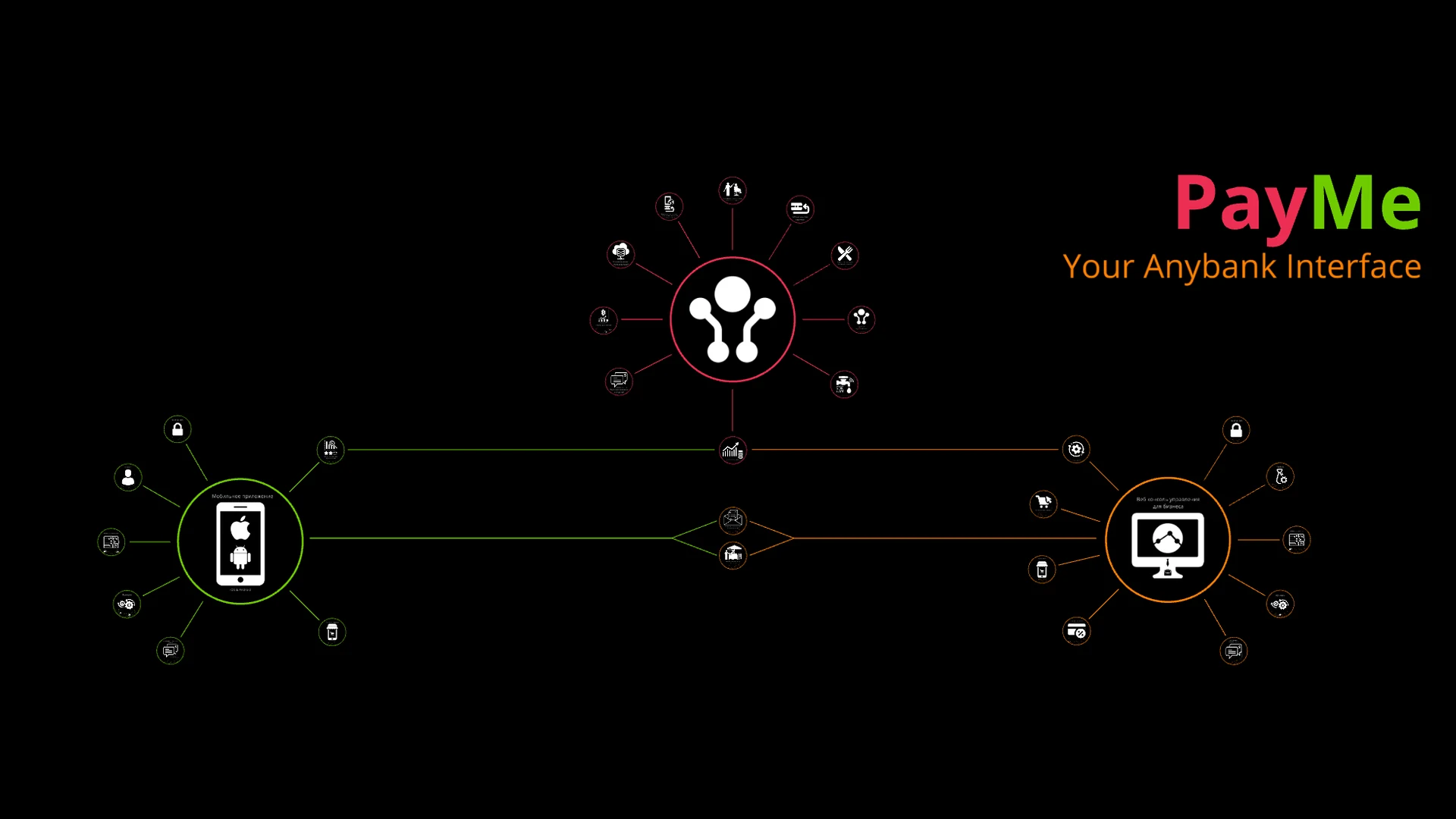
Public architecture overview. Fine-grained product and technical logic is intentionally not reproduced in full.
Context
PayMe was conceived as a platform layer connecting individuals, businesses, merchants, banks and external services. The concept brought together everyday payments and transfers, business operations, merchant tools, digital identity, security, documents, analytics and integrations through a common platform core.
PayMe was developed in 2018 within UNILIX Group by Serhii Kysylenko in collaboration with Ievgen Teroshyn, technical co-author and project partner. It remained a historical concept and was not launched as an operating product.
Condensed walkthrough
Accelerated public walkthrough of the original presentation. The sequence conveys the scale and layered structure of the platform rather than reproducing the complete presentation and its full architecture.
Structure
Mobile financial tools, accounts, payments, transfers, identity and personal financial services.
Transactions, documents, roles, analytics, financial administration and corporate workflows.
Mobile point of sale, QR and NFC flows, billing, payment acceptance, commerce and customer engagement.
Security, data, digital identity, APIs, banking integrations and external digital services.
Project contribution
Product and business concept
Shaped the overall product vision and ecosystem model, market positioning, commercial and partnership logic, coordinated the project and developed the investor-facing and partner-facing presentation of the concept.
Technical co-author and project partner
Translated the product vision into a structured banking and technical architecture, including integration logic, security, data flows, system relationships and the engineering elaboration of the interconnected platform layers.
What this case demonstrates
Working with relationships between users, businesses, infrastructure and services rather than treating functions as isolated features.
Organising a large concept into clear layers, roles, architecture, integration points and development paths.
Turning a product idea into a model in which commercial logic and technical architecture support each other.
About the public version. The original presentation contained substantially more product logic, technical detail and supporting market research. Selected elements have been reduced or omitted from this case study.